Product Introduction
Discover premium industrial stainless steel wire coils for B2B manufacturing. Features high tensile strength, superior corrosion resistance, and precision gauge consistency for automated assembly lines.


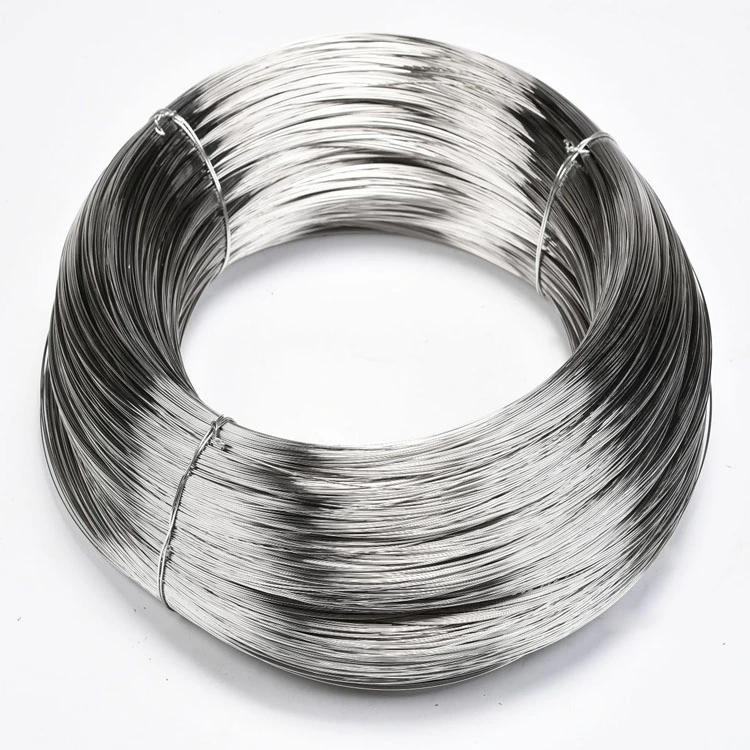
Stainless steel wire combines corrosion resistance, strength, and flexible processing. It can be drawn into fine diameters, formed into springs, woven into mesh, or shaped into fasteners. As a result, it supports a wide range of industrial products.
We manufacture stainless steel wire for machinery, construction, automotive parts, marine equipment, food processing, and general metalwork. Buyers can specify the grade, diameter, tensile strength, surface, coil weight, and packaging method. Moreover, custom production helps the wire run smoothly on automated equipment.
Our production range covers soft wire for bending and harder wire for load-bearing parts. Final specifications are confirmed according to the application and purchase order.
| Product Item | Available Options |
| Material grades | 201, 304, 304L, 316, 316L, 410, 430 |
| Typical diameter | 0.1–16 mm |
| Wire condition | Soft annealed, half-hard, hard, spring temper |
| Surface | Bright, matte, pickled, soap-coated, polished |
| Supply form | Coil, spool, reel, carrier, or straight length |
| Cross-section | Round or custom profile |
| Standards | ASTM A580/A580M, ASTM A313, or agreed standard |
| Testing | Diameter, tensile strength, chemistry, surface |
| Documentation | Mill Test Certificate and traceability records |
| Custom options | Diameter, temper, coil weight, finish, packaging |
Special dimensions and mechanical properties can be developed for regular production programs.
Each stainless steel grade has different forming and corrosion properties. Therefore, selecting the correct grade is an important first step.
304 stainless steel wire offers good corrosion resistance and forming performance. It is widely used for mesh, kitchen products, fasteners, filters, and general industrial parts.
304L stainless steel wire has a lower carbon content. It is suitable for welded wire products where corrosion resistance near the weld area is important.
316 and 316L stainless steel wire provide stronger resistance to salt, chemicals, and chloride exposure. They are often selected for marine products, chemical filters, pharmaceutical equipment, and food processing systems.
201 stainless steel wire provides useful strength for many indoor and general-purpose products. It is commonly used where moderate corrosion resistance is suitable.
410 and 430 stainless steel wire are available for applications that require different hardness, magnetic, or forming properties.
Wire condition affects how the material bends, stretches, or returns to its original shape. It also affects performance on forming machines.
Soft annealed stainless steel wire is easy to bend, tie, and shape. It is a practical choice for binding, weaving, and general fabrication.
Hard-drawn wire has higher strength and better dimensional stability. Therefore, manufacturers use it for pins, clips, screens, and formed components.
Spring-temper wire is designed for elastic parts that face repeated movement. It is suitable for compression springs, extension springs, torsion springs, retaining rings, and other spring products.
The required tensile range can be adjusted through drawing and heat treatment. This allows the wire to match the customer’s forming process and final load requirements.
Variation in diameter or coil tension can interrupt high-speed production. For this reason, we control each drawing stage carefully.
Stable diameter helps reduce tool wear during spring coiling, cold heading, and wire forming. Even winding also supports smooth feeding from the coil or spool. In addition, a clean surface lowers the risk of scratches on finished parts.
Important production controls include:
These controls help buyers maintain stable production across repeat orders.
Stainless steel wire can be used as a raw material or processed into finished components. Its broad grade and temper range supports many industries.
Common applications include:
Food and pharmaceutical equipment makers value its clean surface and corrosion resistance. Meanwhile, marine and chemical companies often choose 316L wire for greater protection in harsh environments.
Construction and architectural businesses use stainless wire for cable systems, mesh panels, binding, and decorative structures. Spring and fastener manufacturers choose hard-drawn grades for strength and repeatable forming.
The wire surface must match the next production step. Bright wire provides a smooth appearance and works well for visible parts. Matte and pickled finishes are suitable for many industrial applications. Soap-coated wire can improve lubrication during further drawing or forming.
We supply wire on coils, spools, reels, or carriers. Straight cut lengths are also available for selected diameters. Coil inner diameter, outside diameter, and unit weight can be adjusted to suit the customer’s payoff equipment.
For export orders, products can be protected with moisture-resistant wrapping, reinforced pallets, wooden cases, or steel frames. Labels can show the grade, diameter, heat number, coil weight, and order reference.
Every production lot is inspected against the agreed requirements. This process helps confirm both material identity and processing performance.
Available inspections include:
Mill Test Certificates can be supplied with qualified orders. In addition, third-party inspection can be arranged based on the project contract.
Different forming machines require different coil sizes, wire hardness, and feeding performance. Therefore, our team reviews the end use before confirming production.
Custom services include grade selection, tensile range control, special winding, surface treatment, straightening, and fixed-length cutting. We also support sample testing before large production runs.
For regular buyers, scheduled supply plans help maintain stable inventory and reduce purchasing pressure. Mixed specifications can also be arranged to improve container use.
Please send the required grade, diameter, tensile strength, surface condition, coil weight, quantity, and application. If possible, include your processing method and applicable standard.
Our team will review the details and provide a suitable production plan, quotation, packaging method, and delivery schedule.